

Take a peak behind the curtain to see what makes Theatre Calgary's iconic holiday production come to life.
While audiences know and love Theatre Calgary’s annual production of A Christmas Carol –– and even come to recognize cast members who return to the holiday tradition year after year –– what they don’t see are the “countless people” behind the scenes who make the magic come to life.
“The number of people it takes to create, design and fabricate this show is phenomenal. More than one hundred people have had their hands on this production,” estimates Theatre Calgary Technical Director Graham Kingsley.
Kingsley has been with Theatre Calgary since 2014. He started work on this production of A Christmas Carol in 2018 for its 2019 debut. “We went all in on the automation of this show,” says Kingsley, noting this production occasioned the purchase of half a million dollars in motorized technical equipment.
“We’re moving twenty-foot spinning houses that are suspended from the roof,” describes Kingsley, listing off the multiple motors, cables and trusses that work in harmony “to synchronize the choreography” of the four structures.
Another example of the show’s advanced automation is when Ebenezer Scrooge’s 10-foot-tall bed pops up from the floor, lifted on a large elevator.
While the automation equipment was purchased for A Christmas Carol, Kingsley says it has been useful for other shows like the large-scale, 2024 premiere of Beaches the Musical. He recounts how the production’s New York-based design team was “blown away” that Theatre Calgary owns such extensive equipment. “It’s a nice feather in our cap,” he adds.
Unlike many theatrical sets that are dismantled and repurposed for future productions, the set for A Christmas Carol returns to the Max Bell stage year after year. As such, Kingsley says the sets are built to come apart easily. When not in use, these sets live in three, “meticulously-packed” semi-trucks. “We have construction drawings of how everything fits in the trucks so we don’t run out of space,” Kingsley laughs.
Kingsley says it was necessary to test some of the set materials to see if they could withstand the cold temperatures of truck storage. He points, once again, to the production’s “brick” houses…structures covered with “bricks” made of thin plastic. “We threw some of these vacuum-formed bricks into a freezer to see how they would fare,” Kingsley says of the testing phase.
While some set pieces are as heavy as they look –– including Scrooge’s vintage wooden desk –– Kingsley says other items can be deceptively light. He points to Scrooge’s four-poster bed as one example of the magic of theatrical set construction. Instead of heavy wooden posts, round steel tubes covered with sculpted foam and truck-bed liner - and then painted to resemble wood - form the stage bedposts. “Paint is a gift to us; we can make anything look like anything,” he says.
Over the years, Theatre Calgary has acquired a collection of “thousands of different furniture pieces and appliances. If something has been in a show, we’ve likely kept it,” laughs Kingsley, referencing “the Indiana Jones-style warehouse” that Theatre Calgary owns off-site.
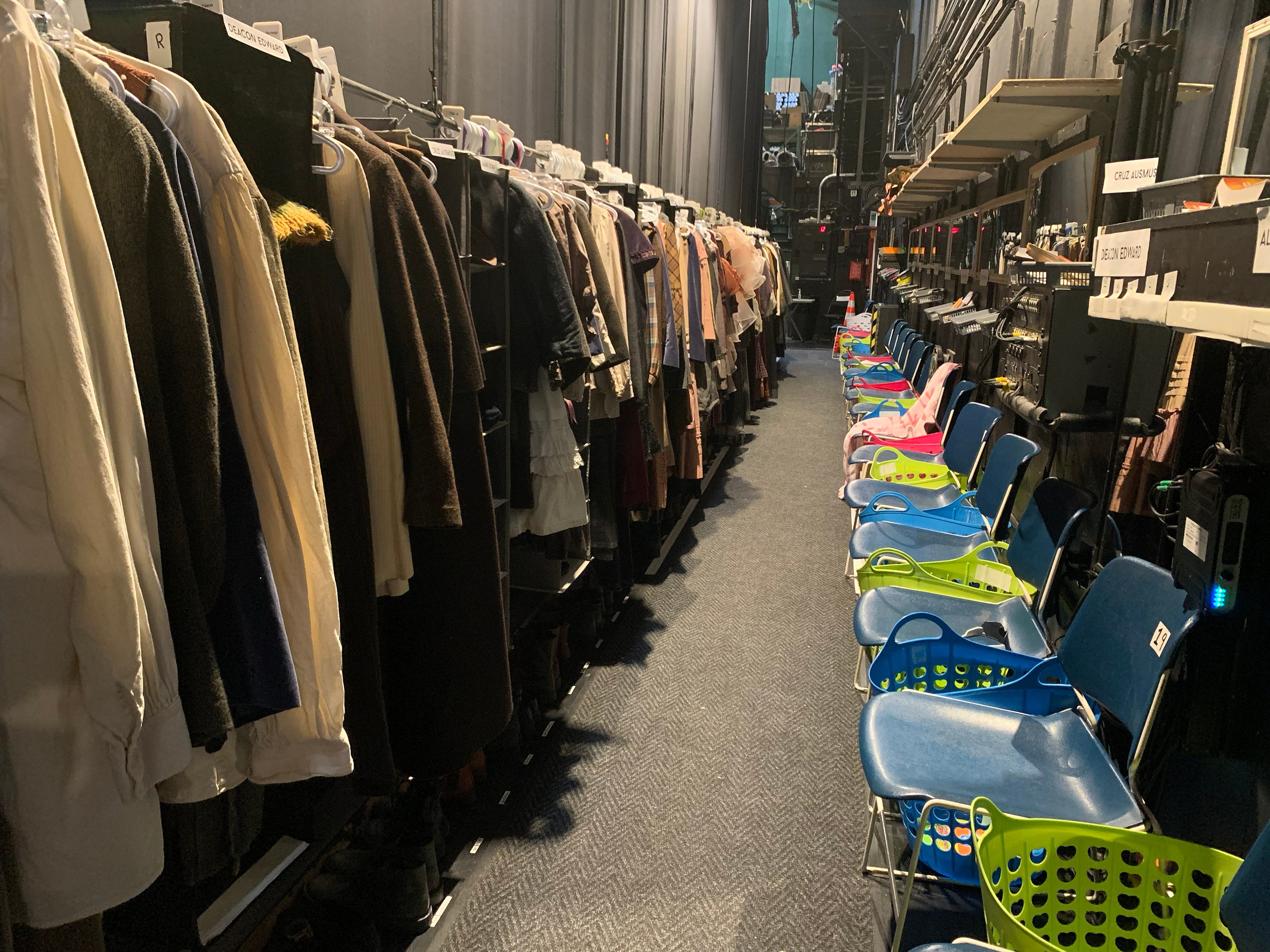
As for the many elaborate costumes in A Christmas Carol, they remain in a basement storage room year-round –– the “Carol Room of Costumes,” as Kingsley describes it. The room is overflowing not only with those costumes seen on stage any given year, but also with many duplicates and extra, period-specific costumes that can be drawn from as the need arises. (There is also a wide selection of crutches to accommodate various sizes of Tiny Tims.)
Kingsley says among the most interesting technical challenges in A Christmas Carol are the special effects around the multiple ghosts who visit Scrooge.
The first ghost who pays Scrooge a visit is that of his late partner, Jacob Marley. He enters the stage wrapped in chains. “We didn’t want the sound of plastic chains; it takes people out of the moment. But real steel chain is incredibly heavy,” Kingsley explains of the conundrum he faced.
“I have spent many hundreds of hours Googling things to see if they exist. I came upon a special aluminum chain for gutters and downspouts. It’s deceptively light, but it has a nice, sharp, metallic ting to it,” he says, explaining how he resolved this challenge.
As another example, Kingsley says the Ghost of Christmas Past is supposed to “glow with a source of light that overwhelms Scrooge.” To this end, Kingsley says he and the design team employ coated fibre-optic cables and lasers which, together, create a glowing, pulsing look throughout the folds of the Ghost’s costume.
One technical change Kingsley says audiences can expect in this year’s production involves a switch from an automated performer flying system to a more “traditional” set-up involving stagehands and counterweights. Christmas Past will fly as the stagehands pull on ropes via “the old-school theatrical way.”
While Kingsley acknowledges productions of A Christmas Carol can be ubiquitous during the holiday season, he is proud to say that while people may know A Christmas Carol, “they don’t know our Carol.”
“This is a big, Broadway-style A Christmas Carol,” Kingsley concludes.
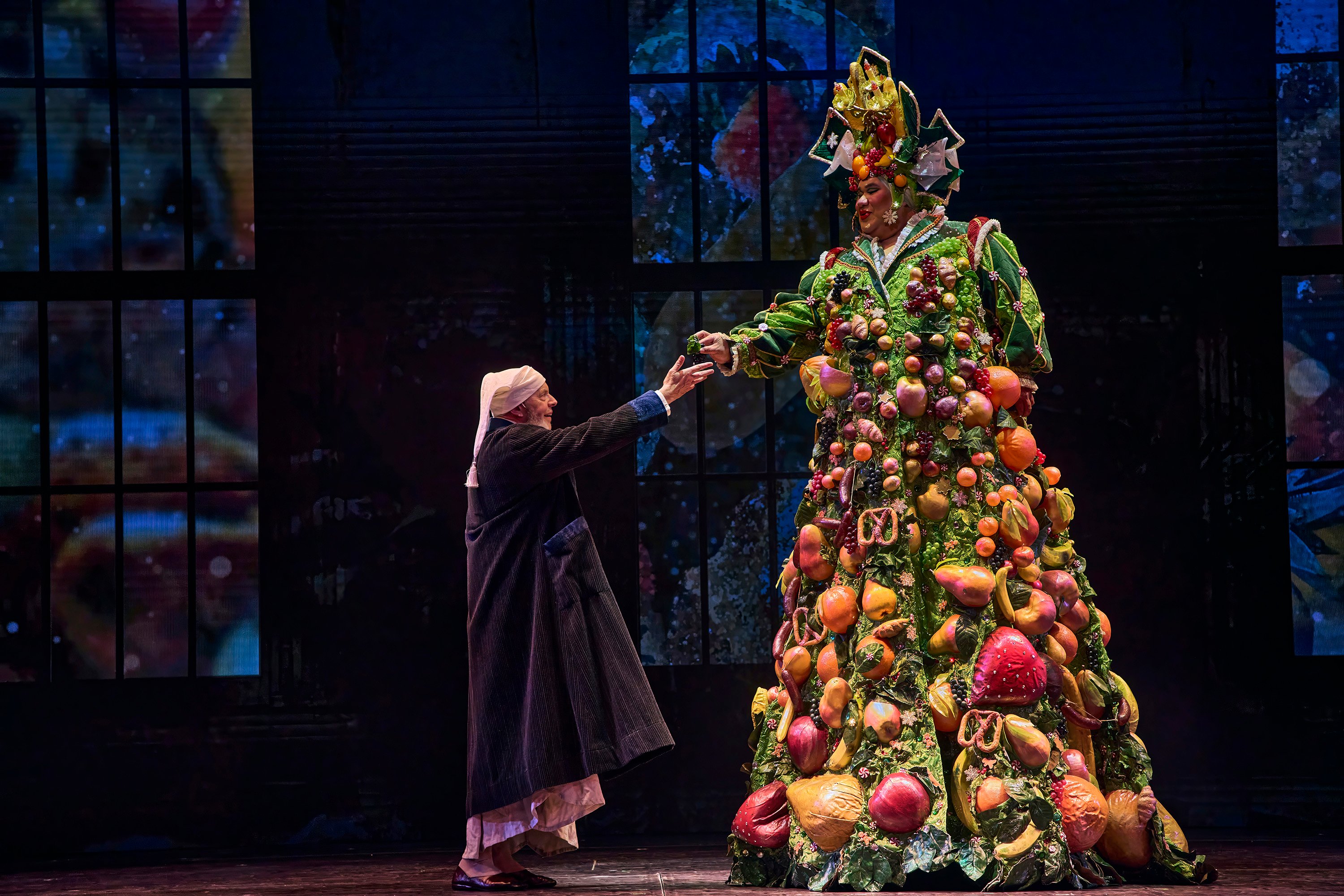
Above image (l to r) Christopher Hunt as Scrooge, Marshall Vielle as Christmas Present. (Photo: HarderLee)
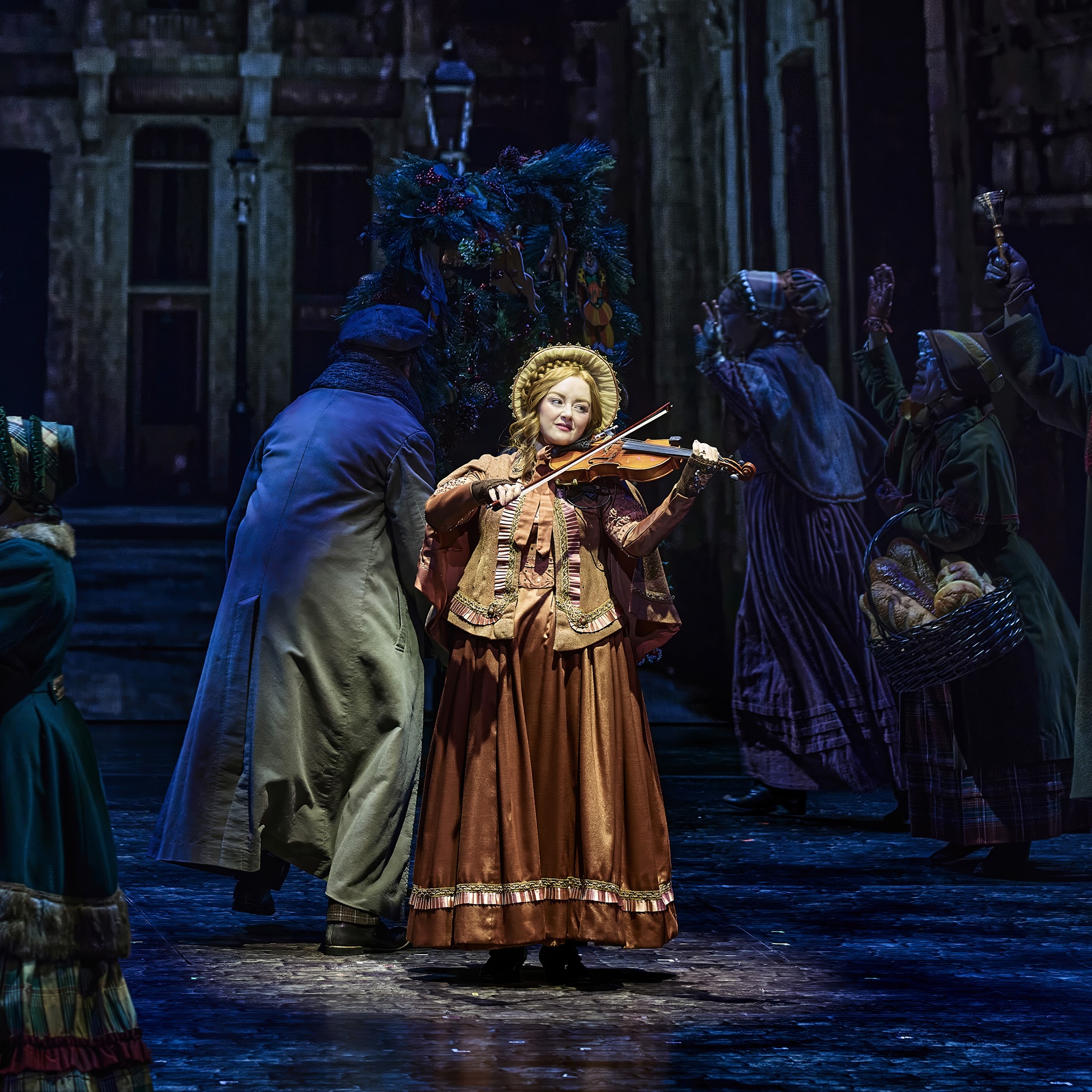
Header image: Allison Lynch and the cast of A Christmas Carol. (Photo: HarderLee)

Kathleen Renne has been following Calgary’s arts scene for the past 15 years. She writes for several local publications and is an aspiring playwright. When not writing or at the theatre, Kathleen can be found indulging her other passion for fashion behind the till at her Kensington clothing store.
Share this post