



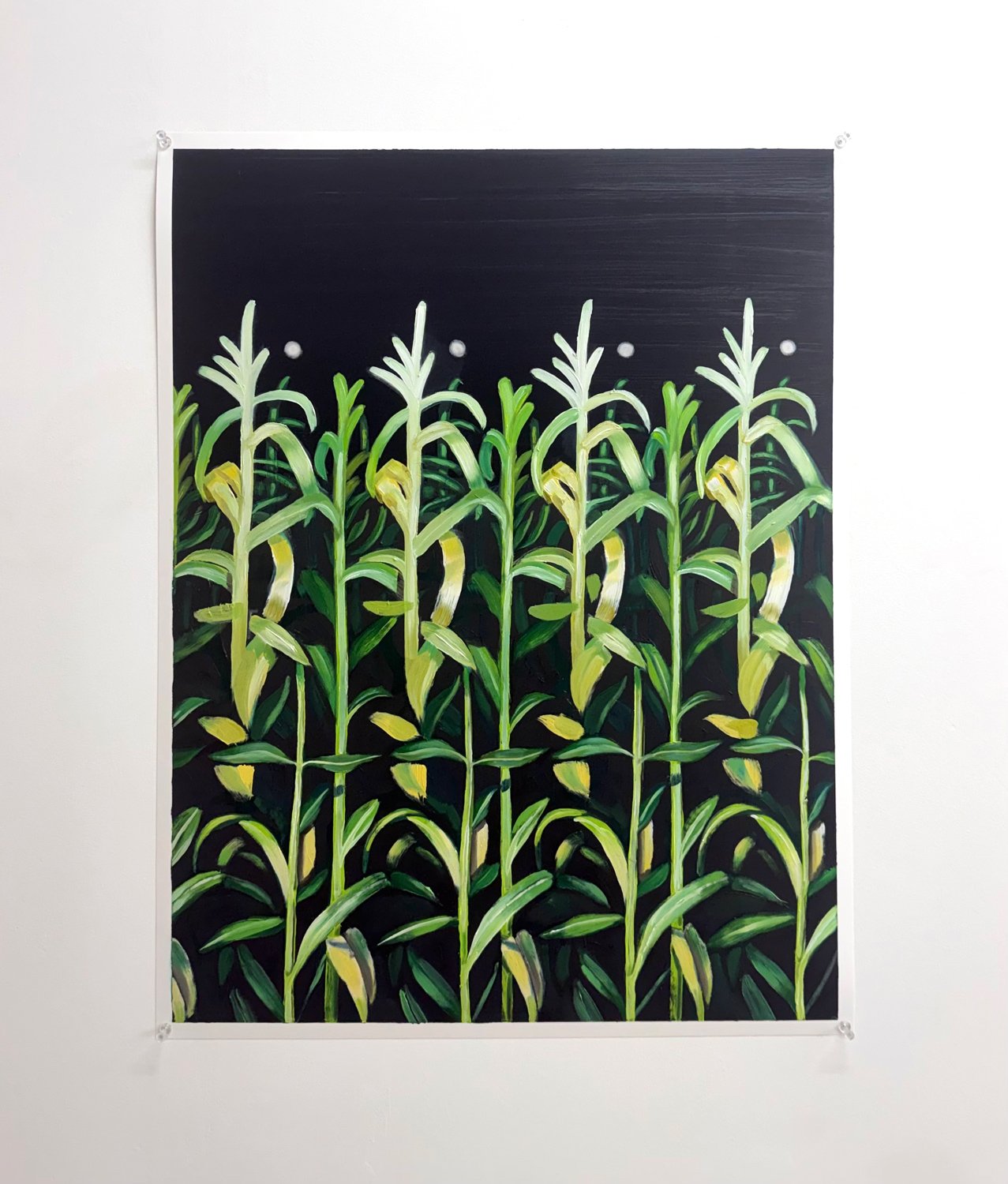
Katherine Langdon
Wall Eyed
October - March, 2027
These paintings bring together familiar imagery of houses, fields, and trees, arranging forms in repeated rows or overlapping them into dense, pattern-like scenes. Set against dark backgrounds, the forms shift subtly, with small differences and interruptions throughout. Some details become lost in the surrounding image, while others only become apparent after looking for a while. The work draws on scenic wallpaper and stereograms, using repetition to play with pattern, scale, and depth. The spacing of the forms can affect how they’re seen, sometimes allowing the eye to find depth within an otherwise flat image. Although each painting is contained on a sheet of paper, the repeated scenes suggest something that could continue beyond its edges.
Second Nature (2026)
Oil on synthetic paper
23” x 25”
Close Quarters (2026)
Oil on synthetic paper
31” x 26”
Home Grown (2026)
Oil on synthetic paper
26” x 20”
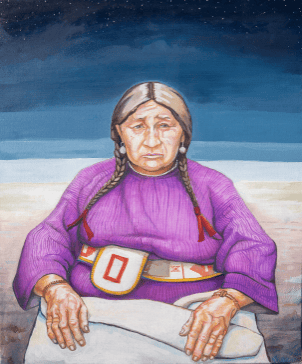
After Water (2022)
Louis Still Smoking
20x24 inch oil on canvas
Honoring our ancestors is a common practice amongst the Blackfeet. Looking at my upbringing as a Blackfeet child, I often reflect on the teachings of my family. Understanding the transfer of knowledge has to be a lived experience. Growing up learning the traditional ways of gathering medicines and food has opened my eyes to the importance of listening. I wanted to use this historical reference photo to convey the importance of generational knowledge and the importance of a woman in Blackfeet culture. The composition is of a Blackfeet woman seated with a trade cloth dress and blanket. The women of our community have large amounts of knowledge that are tied to the land but are also vital to the survival of our way of life. I try to convey this message through rendering the painting so it shows the humanity and presence of the human being. The use of my culture is prevalent in all my work. I hope people can take away a small glimpse of what it is like to be Blackfeet.
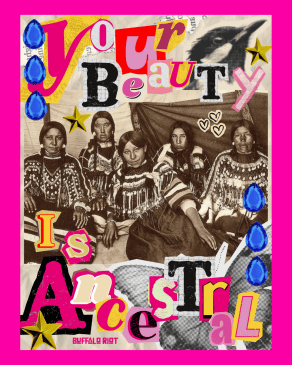
Your Beauty is Ancestral (2025)
O’Maste-Win Crawford- Foster
24x20 inch digital mixed media
Your Beauty is Ancestral is a statement piece centering the beautiful lineage of Pikuni people, while also inviting others to embrace the slogan. This piece is meant for the walls of all our communities as a reminder the standard of beauty is your lineage. It's the tall, strong, broad shoulders. It's the long, thick braids. It's the cloth dresses, stitched with ribbon and sewn in shells. It's the lost names of your beautiful people in photo collections that you see while scrolling the internet. It's the face you see when passing a mirror. It's your matriarchy. I invite all that see this work to look deeply into our shared ancestors, embracing the passed down qualities of those before you and love them deeply.
The Context of the photo: “ Photograph of a group of unidentified Pikuni Blackfeet (Piegan) women on the Blackfeet Indian Reservation in Browning, Montana. Photographed by Norman A. Forsyth between 1906 and 1909.” - Quoted from National Museum of the American Indian Archives Center
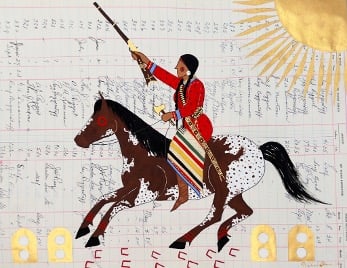
Pi’tamaka (Running Eagle) (2026)
Wakeah Jhane
11x14 inch gouache, watercolor, archival pen ink, and gold pigment painting on antique ledger paper
This piece honors Running Eagle (Pi’tamaka), a Blackfeet woman warrior whose life and legacy in battle continues to resonate for many generations. Running Eagle embodies this rich history of Indigenous womanhood that is often diminished or overlooked within our communities. Rather than depicting a fixed historical moment of her, this piece engages her as an existing living presence carried forward through memory, story and movement. She is depicted in a running motion, mounted to emphasize not only her role as a warrior but also for her strength, autonomy and self-determination. Her and her horse, are painted together in full stride charging forward because stillness doesn’t feel true to her spirit. This represents a visual language of continuity and legacy embodying a willpower that resists being contained.
As a mother, I think a lot about what we pass down without words…strength, instinct, protection, love, bravery. This piece holds that. It carries the blood memory of women who stood firm in who they were, even when the world tried to define them otherwise. Indigenous women as protectors, leaders, carriers of knowledge who’s strength persists beyond what is written and encourages women in modern times to rightfully take their place. However that may look for them and to continue to stand in their power and be true to who we are. She is not distant to me or to any of us. She feels close. A reminder, something remembered in our spirit.
"My artwork to me is my heartwork. It often portrays heartfelt narratives of women’s indigenous agency and familial kinships inspired by our traditional stories and today's modern life experiences. My illustrations are deeply rooted in my physical. emotional and spiritual existence of being a Numu/Gaúigú/Amskapi Piikani/Cwy woman. They elicit the emotions of anyone who genuinely take the time and space to admire, embrace and connect with the pieces. Simply put, My artwork is "Art That Speaks," inscribed on the frail fragments of America's horrific past. Historically, The ledger was more than a record-keeping. It was The tally of settler colonial economies and peoples that occurred on our indigenous homelands. I intentionally repurpose these antique ledgers from the early 1800s to the early 1900s as an act of resistance. This continuation of my lived identity on a historically accurate medium allows the pain of the past to intersect with the love and pain that exists in our present day. Love and pain laced and interwoven together as one. This merging moves into the future as a historical record and modern expression passed down to our future generations. ”
-Wakeah Jhane
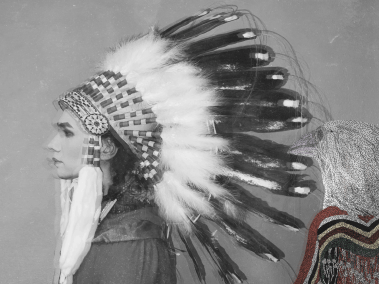
Present (2025)
Jordan Martin (Maistoo’Mahkaa)
24x18 inch mixed media photograph self-portrait
This portrait reflects my identity as a Blackfeet trans artist, grounded in both tradition and transformation. I stand wearing my warbonnet. An emblem of honor, leadership, and responsibility. While adorned with makeup, a deliberate merging of femininity and strength within a sacred lineage. This image embodies the harmony between my gender identity and my cultural identity, asserting that both are integral to who I am.
Beside me stands the White Crow, a visual representation of my Indian name, Maistoo’mahkaa, translated as Running Crow. I was formally given this name at one and a half years old during the opening of the Long-Time Medicine Pipe Bundle ceremony, by the late George Kicking Woman, one of the most respected spiritual leaders in Blackfeet history. In our stories, the white crow symbolizes transformation, wisdom, and the rare. Its presence here reflects my spiritual path and the dualities I hold, between tradition and self-discovery, ceremony and queerness, spirit and flesh.
At four years old, I made a lifetime commitment to community service when I was inducted into the Blackfeet Crazy Dog Warrior Society. This commitment guides my work and life. To be a Crazy Dog is to serve, to protect, to uphold ceremonial protocol, and to ensure that our ways are carried forward with respect and integrity.
This piece is about continuity and truth. It honors the sacred responsibilities passed down to me and reclaims space for trans and Two-Spirit identities within our living traditions. Maistoo’mahkaa is both a reflection and a prayer. A reminder that to exist authentically within one’s culture is itself an act of ceremony.

GET THE
INSIDE SCOOP
Be the first to learn about upcoming shows, ticket sales, behind-the-scenes stories and exclusive info.
Join the email lists now.


