/DonateIcon.svg)

.jpg)
Pink Floyd's middle finger to the rock industry standard.
There are shadows — ghosts, perhaps — that hang over the dour majesty of Wish You Were Here, Pink Floyd’s masterpiece that (secretly, or at least depending on who you ask) might just be their defining statement as vanguards of the experimental limits of progressive rock. Wish You Were Here is defined by its monumental emptiness. It is a barren bulk, a titanic cadaver of a record, of a band that is driven for the most part by the instinctive flight from darkness. A staggering portion of the record’s 44 minutes is lost in ambient ether.
The entirety of its self-contained world lies at the bottom of a chasm black as pitch, loomed over and trapped in the darkness cast down by the shades of its past. It is bleak down there. There is no prism to refract light into a mosaic of colours this time around; through its new lens, the illumination of past days is fractured into a murky dimness. The success of Darkside of the Moon is only part of that tall shadow. It menaces alongside the duppys of the music industry, and the wraiths of their own fraught past. In effect, Wish You Were Here is an album that haunts itself.
If Darkside of the Moon was the peak, the towering mountaintop that Pink Floyd had to take licks to summit, the highest point of their careers and arguably the crest of the entire prog-rock (and/or album cover art) canon, then afterwards, under the weight of their own monstrous successes, they took a tumble. The intervening tour, in which they spent substantial portions of their shows workshopping new material, was seen as lackadaisical and aimless. While their peers — if they had any at the time — surged in the prismatic light they co-opted, it felt like Pink Floyd was falling behind at the heels of their greatest success. Fittingly, recording for the follow-up came on the heels of a review in the Nov. 23, 1974 issue of New Musical Express (NME). The review in question tackles a Floyd concert at the Empire Pool in Wembley, not two weeks prior, where the Roger Waters-David Gilmour-Nick Mason-Richard Wright quartet were testing out new compositions, including an early rendition of “Shine On You Crazy Diamond.” The review was…not kind. The author, Nick Kent, called the new material “bereft of any real originality or inspired conceptualized cognizance,” “some of the most labored bouts of aural padding imaginable,” and opining that Pink Floyd “seem so incredibly tired and seemingly bereft of true creative ideas one wonders if they really care about their music anymore.” That ‘anymore’ is the keyword there. 30 months earlier, Pink Floyd was riding an unprecedented high, universally lauded for the richness of their creative pursuits, and the fearlessness in which they articulated a style of music that had never been. Now, they were seemingly tired, washed out, and cowering in their own wake.
And so, motivated by spite, they sought out receipts. Wish You Were Here, as much as it is a hearkening upon themselves, is also a snarky middle finger to the industry they had a hand in transforming. While you can point to a few names that played a part, very few groups altered the manufacturing and promotional business of music like Pink Floyd. Before they rose, rock radio was held to a strict standard: upbeat or saccharine (choose one), three minutes, verse-chorus-verse-chorus-bridge-chorus. There were no 10-minute improvisations like Piper At The Gates of Dawn’s "Interstellar Overdrive,” no brooding philosophical soundscapes that comprise the magnitude of Dark Side. The same lemures who implemented and enforced those standards, who scoffed at the very notion of a band Pink Floyd, then became the profiteers of a brand they claimed wouldn’t be indulged. You don’t have to read between the lines of “Have A Cigar” or “Welcome to the Machine” to recognize the contempt for the processes of commodification, and the hypocrisy of the executives whose estates were financed on the backs of art they refused to believe in.
And at the core of their hauntings, thrashing and wailing at the centre of Wish You Were Here’s unearthly clamour, like a shackled Jacob Marley begging Scrooge to see the true sins of his manner (Happy Holidays everyone!), is the spectre of Syd Barrett. Barrett left the band before the release of their sophomore LP due to his rapidly deteriorating mental state, though his spirit never strayed too far from the band he co-founded. His presence bookends the album as the tragically radiant inspiration for the gargantuan nine-movement “Shine On You Crazy Diamond.” Despite the quantum leaps Floyd took in both their conceptual structuring and recording processes since the days of Barrett’s stream-of-consciousness frenzied folktales, his influence — perhaps even more on listeners than the band itself — was inescapable. The aforementioned review by Nick Kent is unabashedly biased towards the early Pink-Barrett records, pointedly calling the non-Syd members ‘student architects,’ unfavourably comparing their current style to the work Barrett had done in the band's formative years, even going so far as saying that Barrett deserved better than “Shine On…” and that “incisiveness has never been something the post-Syd Floyd have prided themselves on, and so one has to wade through labored sections of indolent musical driftwood."
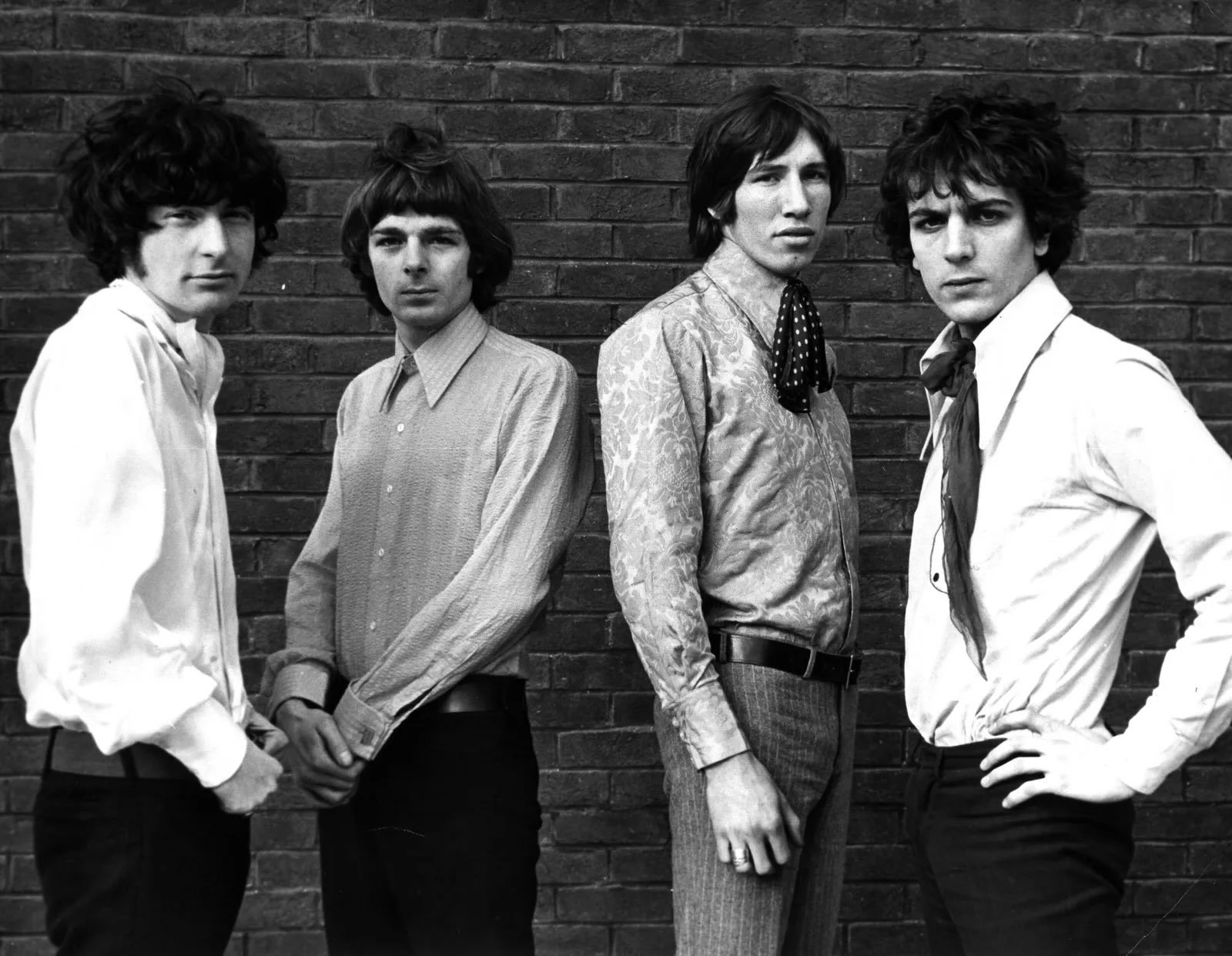 © Michael Ochs Archives/Getty Images. From left to right: Nick Mason, Richard Wright, Roger Waters, and Syd Barret
What’s most chilling about Barrett's eerie presence on Wish You Were Here is that at the time of recording — keeping in mind he was only a full-time member for two of their nine albums so far — he was still very much flesh and blood, and quite literally materializing among them. Syd Barrett, the band’s ever-present muse and subject, appeared unannounced in the studio as the band finalized the mix for “Shine On…” He was overweight with a freshly shorn scalp, living for the past few years in isolation. He carried a plastic bag and reportedly spent much of his studio time brushing his teeth, breaking several times to mutter incomprehensibly to himself. Only Wright recognized him. He seemed to have no understanding of his importance to the song dedicated to him. Apart from a brief appearance at Gilmour’s wedding later that eve (which he left unobserved), it was the last interaction he ever had with his band.
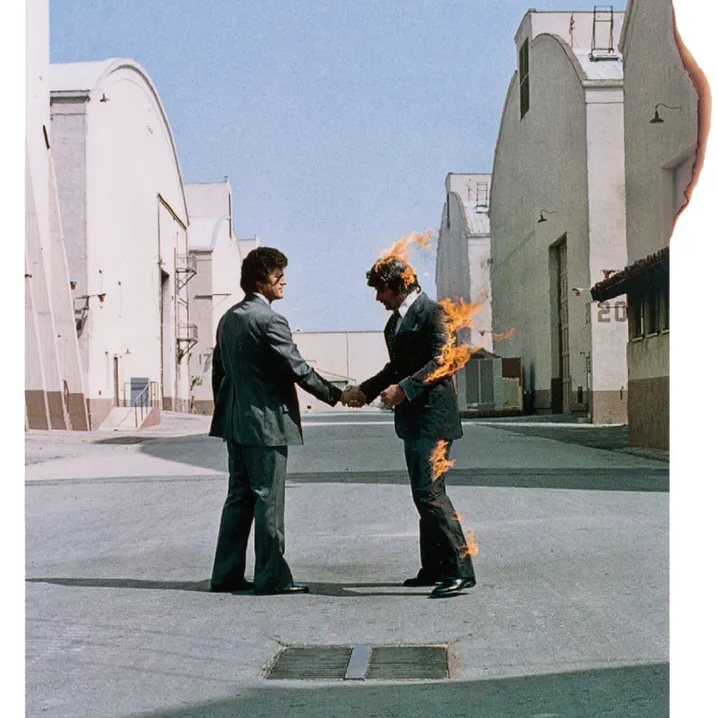
Like so many disruptive and unconventional artifacts, Wish You Were Here was released to lukewarm critical reception. One can understand that, after Dark Side, expectations would be stratospheric and thus unrealistic. So they were. Some reviews called the album simply ‘devoid,’ which years later may in fact be its guiding principle. From the title to the liminal space of its songs to the symbolism of an empty handshake with a burning suit, it is an album fundamentally concerned with lack. Yet somehow, in the emptiness, Pink Floyd found something special. It’s dreary, aggrieved and haunted throughout. Sometimes, that’s all it takes to find a masterwork in the darkness.

Thomas Johnson is the tallest rap critic in Calgary. His work has yet to appear in the Louvre. You can find him listening to all sorts of everything at Blackbyrd Myoozik.
Share this post